How to go from practical experience to fully qualified electrician
If you’re already working as an electrician’s mate or this something you’re considering, you might be wondering what the next steps are in your electrical career. Below, we’ll walk you through the typical pathway from working as an electrician’s mate to becoming a fully-qualified electrician.
Working as an electrician’s mate is an excellent way of developing priceless on-the-job experience while working towards your qualifications. If you’re not on an apprenticeship, it offers the chance to earn a wage as you learn the trade.
While it is a fantastic way of building skills early on in your career, working as an electrician’s mate is not a direct replacement for formal training, and you’ll still need to complete industry-standard qualifications if you’re looking to become an electrician.
What is an electrician's mate?
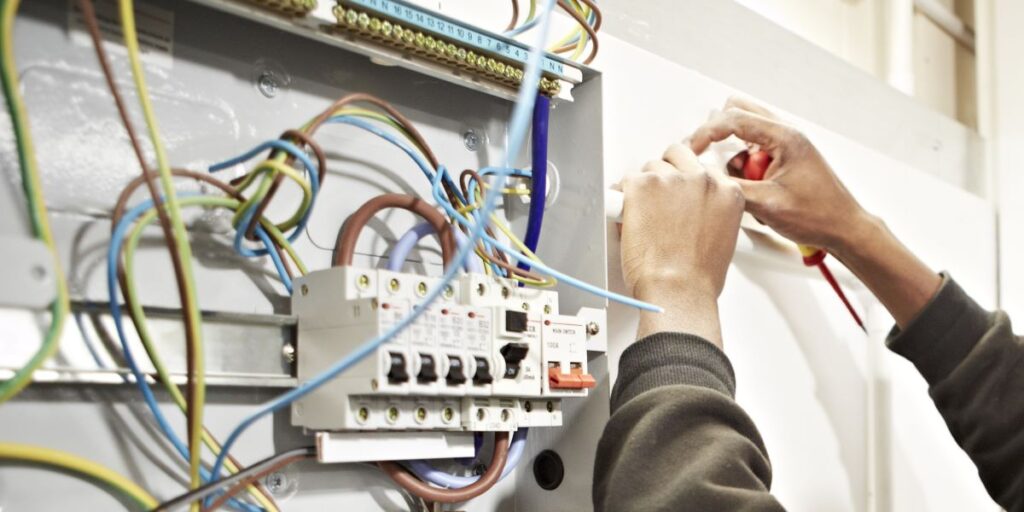
In a nutshell, an electrician’s mate supports a qualified electrician with basic electrical tasks. This role is often used to complement training with experience on the tools.
What kind of tasks can electrician’s mates assist with?
- Preparing work areas
- Observing and assisting with basic wiring and cable laying
- Fetching materials and equipment
- Helping with the installation of lights, sockets and switches
What are the benefits of gaining experience as an electrician’s mate?
The most obvious benefit is the on-the-job experience you’re able to gain while you’re earning.
As well as developing a strong core technical understanding of the electrical industry, electricians’ mates can develop problem-solving, communication, attention to detail, and the ability to work well with others.
Working as an electrician’s mate is a chance to begin growing your network within the industry, too. If you prove yourself reliable and make a good impression, it could even lead to work opportunities further down the line.
Do electricians’ mates need qualifications?
No, an electrician’s mate does not need formal electrical qualifications, so long as they are only assisting and under the constant supervision of a qualified electrician when carrying out any kind of electrical task.
An exception to this would be electricians’ mates who need to assist on a construction site, in which case, they’ll need to obtain an Electrotechnical Certification Scheme (ECS) card. In most instances, the Electrical Labourer card (white with green stripe) will be the necessary accreditation, requiring the holder to pass a relevant Health, Safety & Environment Test, if they don’t already hold any formal JIB-approved qualification.
While not mandatory, holding or working on a Level 2 diploma could help you stand out, as you’ll have a base level understanding.
Where do I start with electrical qualifications?
Below is the typical training pathway for a trainee electrician who isn’t opting for an apprenticeship route:
Level 2 diploma, accompanied by experience as an electrician’s mate
For newcomers to the industry, a City & Guilds Level 2 diploma is the recognised entry route to the electrotechnical industry, combining hands-on installation practice, electrical theory and wiring regulations.
This essentially forms the core of your electrical knowledge, opening the door to more advanced training.
Whether you opt to begin your Level 2 training before gaining experience as an electrician’s mate or vice versa is completely up to you, though the foundational knowledge a Level 2 diploma provides could aid in securing work.
Level 3 diploma and 18th Edition
Next, the natural progression is to move on to a Level 3 diploma. This covers more advanced electrical units across electrical science, inspection and testing procedures, fault diagnosis, rectification and installation design.
While not mandatory at this stage, many electricians naturally tend to also complete their 18th Edition assessment either during or shortly after completing their Level 3 diploma. This ensures you have an up-to-date understanding of the latest UK wiring regulations. Many employers will expect you to have completed the 18th Edition before hiring you, which is essential in moving onto the next step…completing your NVQ.
NVQ Level 3 and AM2 (qualified electrician)
At this point, you’ll need to begin working in the industry. That’s because the NVQ Level 3 is a work-based competence assessment, during which you’ll gather a portfolio of work to prove your skills and safety compliance.
Either after or during the very final stages of completing your NVQ Level 3, trainee electricians will also need to complete an AM2 assessment. The AM2, which is laid out by the National Electrotechnical Training (NET) Organisation, is a predominantly practical assessment (with a short online component) in which you must complete a series of electrical tasks in compliance with the latest wiring regulations, and in line with health and safety legislation.
JIB Gold Card
Once all of the above have been completed, you’ll be in a position to apply for your JIB Gold Card, proving your status as a fully qualified electrician, and therefore being able to carry out electrical installation work unsupervised. To be eligible, you must have passed an ECS Health, Safety and Environment Test within the last two years.
FAQs about being an electrician’s mate
Do electricians’ mates need qualifications?
No. You do not need formal qualifications to begin working as an electrician’s mate. However, completing some, or all, of a Level 2 electrical diploma could help you stand out when seeking work.
Do I need qualifications to begin a Level 2 electrical diploma?
No. The City & Guilds Level 2 diploma is aimed at newcomers to the industry, so you are not expected to have any prior experience or qualifications.
How can I find work as an electrician’s mate?
Keep an eye on job boards and LinkedIn for vacancies and consider signing up to specialist construction recruitment agencies. Aside from that, don’t be scared of reaching out directly to businesses and local contractors, and check for potential work leads in relevant social media groups.
What is the difference between an electrician’s mate and an electrical improver?
An electrician’s mate isn’t necessarily expected to have completed any kind of formal electrical training and therefore can only perform basic tasks under constant supervision. An electrical improver will generally have completed a Level 2 or Level 3 diploma, meaning you can undertake a broader scope of electrical tasks.
Getting started with electrical training
If you’re preparing to take your first steps towards a career in the electrical industry, Able Skills offers a range of expert-led courses, including standalone Level 2 and Level 3 diplomas, packages that combine both, NVQ assessments, 18th Edition and an in-depth Gold Card Electrician package, designed to take you from novice to fully-qualified.
“I’ve completed several electrical training courses with Able Skills, most recently achieving my 2391 qualification.. I’m very pleased with the experience and would highly recommend Able Skills to anyone looking to advance their electrical training.” - via Trustpilot
Courses can be completed on a flexible basis, with weekend training and home study options. We also have affordable accommodation near our industry-leading training facilities for anyone travelling from further afield.
To find out more, contact our friendly team on 01322 280 202 or hello@ableskills.co.uk, or feel free to visit us at our Dartford training centre during opening hours.
 Electrician Training