If construction is a career path that’s calling to you, you might have started looking at training pathways and career progression. This guide to plastering and rendering courses, looks at practical training in plastering, as well as rendering techniques training, plastering qualifications and where construction trade courses can take you.
About plastering and rendering
What is plastering and rendering?
Both plastering and rendering processes are about finishing the surface of a wall or ceiling. They use a wet substrate (plaster or render) which is applied over boards, blocks or brick to coat the wall. The plaster or render then sets hard into its fixed position to form a finished layer before the decorating. Once the plaster has ‘gone off’, it’s ready to mist coat (often misheard as “miss coat”) and decorate.
Plastering is typically used in interiors. Rendering is usually for exteriors, though there are some exceptions, as rendering can be used for decorative effects inside as well.
While both are an essential part of construction, providing various benefits including increased soundproofing, insulation, or weather protection, they form part of the overall aesthetic of the room or the structure. A smoothly plastered wall improves the overall paint finish or provides a uniform surface for wallpaper. A considered rendering finish creates a design of its own on an external wall.
Different plastering and rendering tools and techniques
Internal plastering involves applying wet plaster to ceilings and walls. This is done using floating and skimming techniques over plasterboard or by applying direct bond over existing uneven walls before final plastering. Beads are cut and fixed around reveals; this gives an edge to work the plaster to for a neat finish.
In external rendering techniques plasterers use dots and screeds to gauge and guide the depth of the render before filling out with render and ruling off using a featheredge.
Common plastering tools include trowels, hawks, floats, featheredge, dry wall rasp and jab saw. Plasterers will also use general tools including tape measures, levels, screwdrivers, Stanley knife, sponges and buckets.
Where this trade can take you
Like all trades, there is an ongoing demand for plasterers and renderers who do good quality work. As with other professions, once you’re working in plastering, there are opportunities to specialise or to broaden your scope of work.
In terms of how you work, you might look for employment opportunities or decide to become self-employed. You might consider site work or working in property maintenance. In the residential sector, plastering forms an essential part of property renovation, home improvements – think of home extensions or garage conversions – and even repairs.
Beyond working as a plasterer, you might decide to start your own business. With experience, another route might take you into construction site supervisor roles and management opportunities.
How to become a plasterer
With construction trades, there are several routes into the profession. Apprenticeships and college courses are the go-to for school leavers. Starting work as a labourer or plasterer’s mate is another route in.
If you’re looking to learn the skills and enter the industry more quickly, then a plastering and rendering course at a construction training provider can offer you an industry-ready City & Guilds certificate and training in 8 weeks. This will give you the opportunity to gain practical workshop experience in the trade while under the supervision of an experienced instructor who themselves has done the job.
Beginner plastering courses
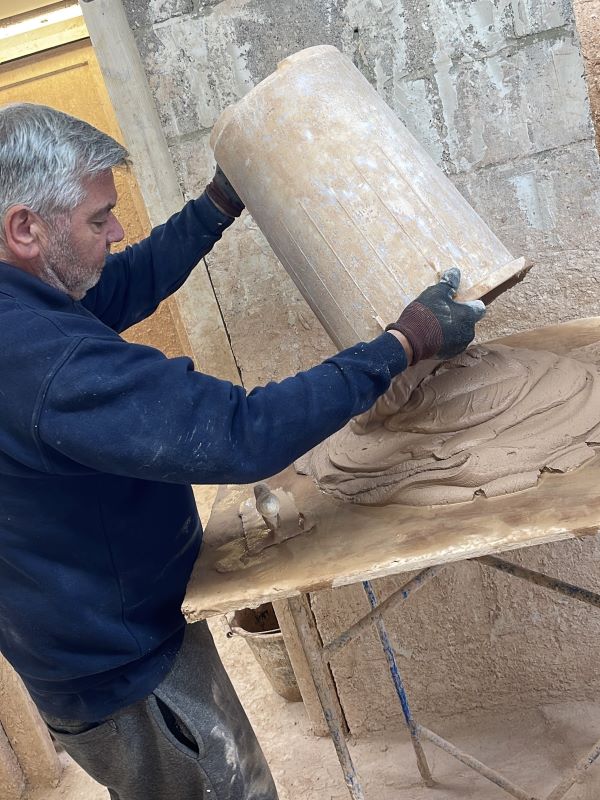
Even if you’ve never picked up a hawk and trowel before, a beginner’s plastering course will get you on the tools quickly and cover the basics of plastering over a short period of time. The huge benefit of doing a beginner’s course first is that you can find out if you enjoy the work before committing to a full professional qualification.
“With plastering there’s so many different skills that you need to learn… the pressure you're putting on the trowel. The angle of your wrist. The consistency of the plaster. The weather! So many variables.” - Interested in DIY plastering? Read Kiki & Charlie’s Student Story.
At Able Skills, because our Introduction to Plastering is a City & Guilds approved course, the week’s block of learning can transfer over to a longer course if you decide to pursue the professional training.
Professional plastering and rendering qualifications: NVQ qualification route
To get full training under your belt that reflects the reality of working full-time, on-site as a plasterer, consider a plastering course that trains you to NVQ Level 2. This type of course will give you 8 weeks of practical training in plastering so that you are ready to work in the industry and you’ll hold a City & Guilds certificate. At this point, you’ll be fully prepared for the NVQ process, having done the training and assessments across the areas of work that are applicable to the NVQ Level 2.
As part of the NVQ process, candidates need to understand safe working practices, including the correct use of PPE, manual handling and working safely on construction sites.
The next step is finding work, getting a CSCS Experienced Worker or Trainee card, and registering for the NVQ plastering.
FAQs about plastering and rendering courses
Is it hard to learn plastering?
Plastering is hard work, and learning anything new presents a challenge to start with. But with patience and practice, most people can start to pick it up within a few days.
Can you learn plastering by watching a DIY video?
While you can in theory learn some of the techniques and skills by watching others plaster while they explain what they’re doing on a YouTube video, there is no replacement for hands-on learning under the guidance of an experienced, time-served plasterer. It’s impossible to gauge the pressure you’re putting on the trowel or the consistency of the plaster without experiencing that alongside someone showing you and then doing it yourself.
How long does it take to learn plastering?
Within a few days most people can pick up the basics of plastering. After a five-day plastering course, you’ll have enough knowledge and skill to tackle some DIY plastering jobs. A professional plastering course gives you time to learn more advanced skills and build up speed, so you’re industry ready.
What qualifications do plasterers need?
Like many trades, formal qualifications aren’t necessarily required before starting work. There are entry routes where you can learn on the job. That said, industry-recognised qualifications can help you stand out if you’re considering plastering as a new career. An NVQ Level 2 in plastering becomes essential if you’re looking to apply for your Blue (Skilled Worker) CSCS card.
Do I need an NVQ in plastering?
Whether you need an NVQ in plastering or not depends on your end goal. If you want to work on construction sites in the UK, nearly all require workers to hold CSCS cards. To apply for the Blue Skilled Worker card, one of the requirements is that you hold an NVQ Level 2 or equivalent qualification.
How can I train ready for an NVQ Level 2 in plastering?
NVQs are declarations of competence evaluated in the workplace, but to help you prepare for that, you can choose a plastering course that trains you to that level. The right NVQ-ready plastering course will fully prepare you for the NVQ process.
How do I find an external rendering course or a skimming course near me?
To find a rendering or skimming training, search for a City & Guilds approved plastering course and read their reviews. Visit their training facilities, if you can, or call them to discuss the course first, to make sure it covers what you need and gives you the correct construction qualification.
How to get started
Plastering and rendering courses at Able Skills
“I recently did the 5-day introduction to plastering. Neil was my instructor and was a top guy. I was fully supported throughout the week, everything was explained well and I’ve come away with a lot of confidence. 5* from me.”– Review via Trustpilot.
Able Skills in Dartford has a ground floor plastering department, where we teach plastering and rendering, and dry lining courses. The purpose-built training area is sectioned into rooms, so students can practice plastering ceilings and walls, and also board out rooms and plaster over, while working around windows and doors.
As a City & Guilds approved training centre, we hold a mark of excellence in construction trade courses. Our students can be assured of training and qualifications that get them ready to enter the industry.
If you’d like to find out more about plastering and rendering courses, contact our team today by phone or email.
 Plastering
