From photographer to fully qualified electrician, find out how Paul went from cameras to cables in a career change to a secure future.
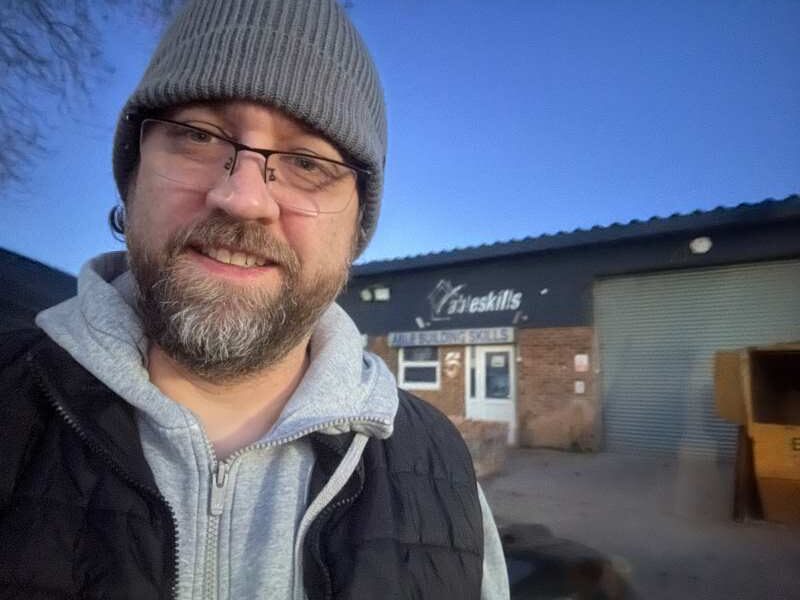
Careers don’t always happen in a straight line. Sometimes circumstances force us to reevaluate our jobs as we look towards the future. In Paul’s case, it took him full circle, taking years of practical experience and turning it into a professionally qualified career.
We caught up with Paul following his AM2 exam in January to find out more about his journey to becoming a fully qualified electrician.
We're always interested to find out what prompts a career change to trades. Why train to become an electrician and why now?
I worked as a professional photographer for 20 years. When COVID hit, it forced me to rethink my future and look for something more stable where I could use my practical skills to build a long-term career.
From a young age, I learned DIY skills from my dad. As a teenager, I renovated six houses and later spent a year as an electrician’s apprentice on a Tier One construction site. I also worked on domestic rewires and home improvement projects with family and friends.
Electrical work felt like a natural fit — practical, technical, and problem-solving, with a strong attention to detail.
You’ve been training at Able Skills for a while. When did you start and how long has the electrician training taken?
I started at Able Skills in January 2024 with Level 2, progressed to Level 3, completed my 18th Edition and then moved onto my NVQ.
In January 2026, I passed my AM2. That was a real milestone — not just passing the assessment, but knowing the experience behind it was solid. That’s when I could confidently say I was a fully qualified electrician.
Gaining experience on-site is a huge part of the process. Once you’d started the training, when did you start working in the industry, and how did that come about?
I started working in the industry in 2023 on the rewire of an adult skills college, before beginning my formal training. It reintroduced me to a structured site environment and bridged the gap between past experience and professional electrical work.
The opportunity came through a personal connection. Once on site, it was up to me to learn quickly, take instruction, and prove myself.
I gained experience with cable tray and basket, metal and PVC conduit, data, alarm and fire alarm systems, singles, SWA, and more — areas I hadn’t previously worked with in depth.
Thinking back over your time at Able Skills, is there anything you didn’t expect during the training, and what did you find most challenging?
The Level 3 project was tougher than I expected. It forced me to slow down and think carefully through every stage — from planning and accuracy to fault-finding. Although challenging at the time, it was the point where everything started to click and my standard of work noticeably improved.
Balancing site work while completing the NVQ was demanding, particularly finding the right opportunities to cover each section. Fortunately, the roles I was in exposed me to most of the required elements. I found it helpful to keep a video diary and use time-lapse recordings to capture evidence, which proved very effective.
Testing was another area I found challenging, mainly because I didn’t get enough hands-on practice initially. To improve, I made a conscious effort to focus on it — studying in my own time, watching guidance videos, and regularly referring to Guidance Note 3. Looking back, it taught me an important lesson: when something feels like a weak area, it’s better to lean into it and actively build experience rather than avoid it. That mindset has stayed with me beyond the training.
That's a great piece of advice. What other advice would you give to current students who are just starting on their Level 2 or Level 3, gathering evidence for their NVQ or preparing for the AM2?
If I could offer a few pieces of advice to anyone currently training to become an electrician, it would be this:
- Plan ahead and commit fully
Able Skills is extremely popular, so book early, plan your training and treat it like the professional commitment it is. No one will do the work for you.
- Get on-site as soon as possible
The training bays at Able Skills are excellent, but real confidence comes from applying those skills in live environments.
- Tackle your weak areas early
Confidence comes from repetition and experience, not avoidance.
- Document everything
Take photos, videos, and notes. You never know when they’ll be useful for your NVQ — and many tasks will need to be evidenced more than once.
Training for a new career takes hard work and determination. What has been the highlight of your journey so far?
The biggest highlight was completing the AM2 and knowing I had genuinely earned it. The confidence I took into the assessment came from the depth of training at Able Skills, combined with two years of real-world site experience.
My journey — from hands-on renovation work to photography and ultimately to becoming a qualified electrician — wasn’t a straight line, but it was the right one for me. The period around COVID prompted me to rethink priorities, and it was the catalyst to turn years of practical experience into a recognised, industry-ready profession with a clear future.
Able Skills didn’t just provide the qualifications — it provided clarity, confidence and a structured path forward that made the goal feel achievable from start to finish.
Paul took control of his pathway towards becoming a fully-qualified electrician by completing the training on his terms, breaking it down into a step-by-step clear progression route.
Two years to get fully qualified: January 2024 → Started Level 2 at Able Skills → Progressed to Level 3 → Completed 18th Edition training → Started NVQ → Passed AM2 assessment and became a fully qualified electrician in January 2026
When it came to time on site, the NVQ was always front of mind, so he never missed an opportunity to gather evidence or build experience. Paul continues to share his journey from training bays to working on-site on LinkedIn.
 Electrician Training
